Peptide Publications Archive
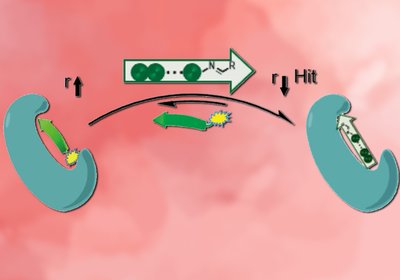
Fragment Capping PDZ
Wilson Lab
β-strand-mediated protein–protein interactions are among the hardest targets in chemical biology, and PDZ domains are notoriously resistant to small-molecule ligands. A dynamic ligation screen against …
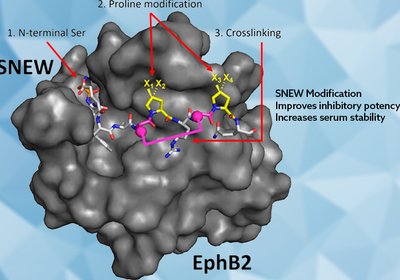
Stabilizing SNEW
Sawyer Lab
The EphB2 receptor drives several cancers, yet its best peptide inhibitor, SNEW, has languished with modest potency and poor serum stability. Swapping its N-terminal serine …
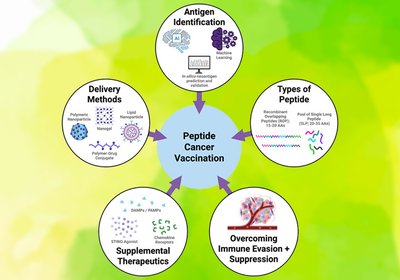
Priming the Attack
Kimmel Lab
No peptide cancer vaccine has yet earned FDA approval, yet the field is converging on strategies that may finally close that gap. A new review …
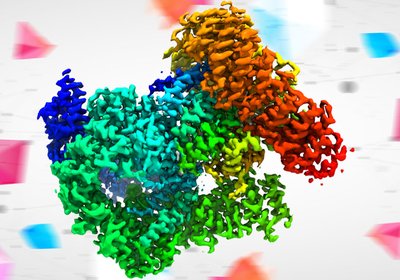
Hunting Huntingtin
Harding Lab
Huntingtin, the protein at the center of Huntington's disease, has long resisted selective chemical interrogation. A new suite of macrocyclic peptide tools now binds it …
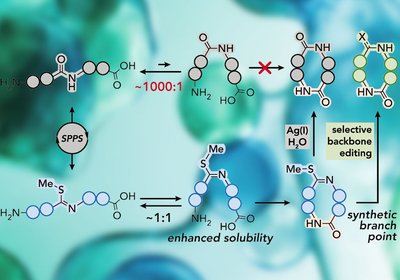
Unlocking Small Macrocycles
VanVeller Lab
Short homochiral peptides routinely defeat macrocyclization attempts, either failing to close the ring or dissolving poorly enough to prevent even trying. A single backbone thioimidate …
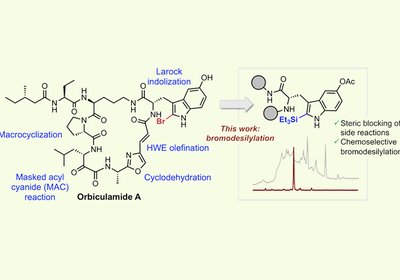
Taming Bromine
Perrin Lab
For 35 years, the marine macrocycle orbiculamide A resisted total synthesis, largely because its 2-bromo-5-hydroxytryptophan residue defeats every conventional bromination strategy. Now, a chemoselective late-stage …
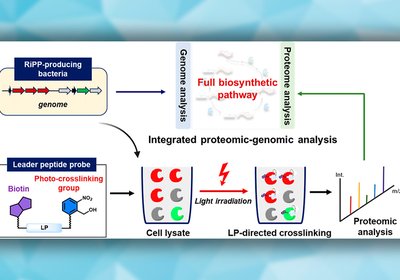
Mapping Hidden Enzymes
Wang Lab
Genome mining reliably maps biosynthetic gene clusters for ribosomally synthesized and post-translationally modified peptides, RiPPs, yet routinely misses enzymes encoded elsewhere in the genome. A …
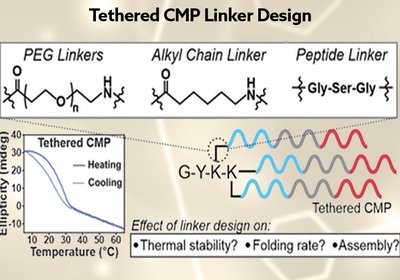
Linkers Shape Collagen
Merg Lab
Covalently tethered collagen-mimetic peptides fold into triple helices and assemble into nanosheets, but how does the linker connecting each strand to its scaffold influence stability? …
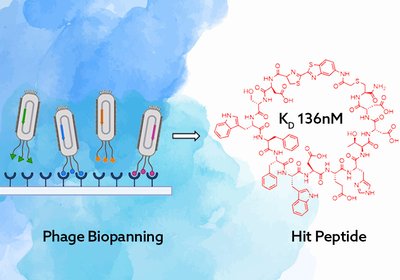
Cornering RhoA G17V
Liu-Hampton Lab
RhoA G17V drives nearly 70% of angioimmunoblastic T-cell lymphoma cases yet has resisted every small-molecule effort for decades. Now, a phage-displayed macrocyclic peptide library yields …
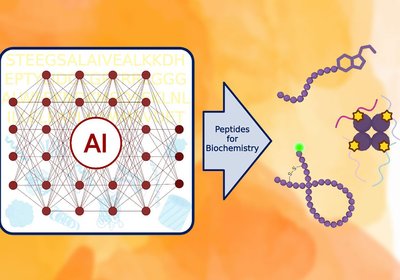
Peptides on Demand
Chatterjee Lab
Antibodies dominate biochemical research, but their context-dependent performance, reproducibility problems, and opaque binding determinants leave scientists wanting better tools. A new review from the Chatterjee …
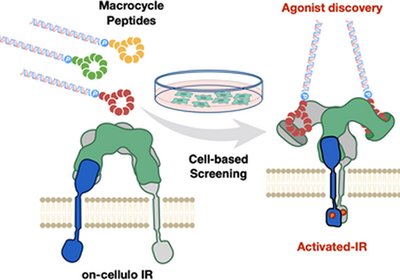
Function-First Macrocycles
Suga Lab
A new cell-based mRNA display platform bypasses affinity-only screening to discover a macrocyclic insulin receptor agonist that conventional methods would have missed...
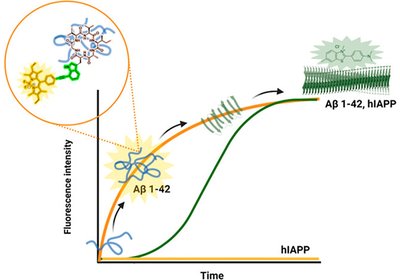
Lighting Up Oligomers
Tonali Lab
A cyclopeptide-BODIPY conjugate built from Alzheimer's own amyloid sequence outperforms antibodies at spotting toxic prefibrillar aggregates inside neurons
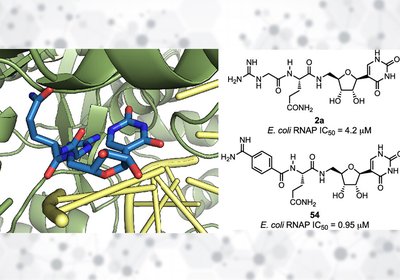
Stabilizing Pseudouridimycin
Del Valle Group
Cryo-EM guided solid-phase synthesis yields 50 stabilized pseudouridimycin analogs, including a para-phenyl amidine that inhibits bacterial RNA polymerase fourfold better than the parent compound
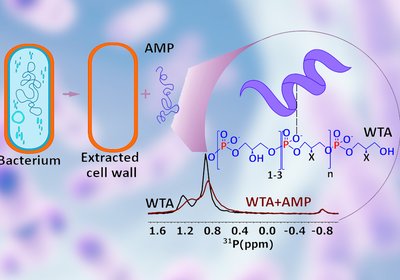
Beyond the Membrane
Marcotte Lab
Researchers supervised by Professor Isabelle Marcotte at the Université du Québec à Montréal, published in J. Am. Chem. Soc., investigated three amphibian-derived AMPs with …
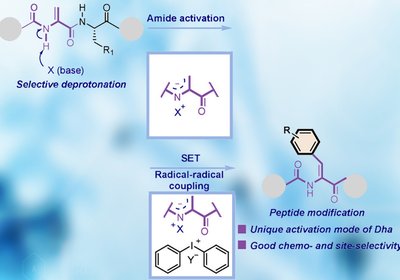
Activating Dehydroalanine
Liu and Wang Groups
A previously overlooked deprotonation of the dehydroalanine amide N–H unlocks selective arylation of peptides under mild conditions, with no metal catalyst required
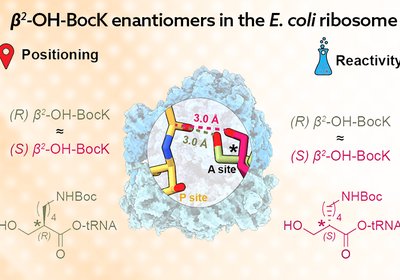
Backbone Sensitivity
Cate & Schepartz Groups
Researchers in the Cate and Schepartz Groups at the University of California, Berkeley, and the Lawrence Berkeley National Laboratory, published in the Journal of the …

Leaderless Death Caps
Pringle, Keller, & Drott Labs
Researchers in the Pringle and Keller Groups at the University of Wisconsin-Madison, published in PNAS, combined chemistry-guided metabolite isolation with an updated bioinformatic pipeline …
Bismuth Bicycles
Spring Group & Bicycle Therapeutics
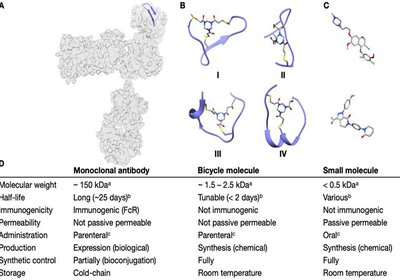
Researchers in the Spring Group at the University of Cambridge, working in collaboration with Bicycle Therapeutics, explored bismuth(III) as an alternative scaffold for bicyclic peptide …
Scaling Azapeptides
Lubell Lab
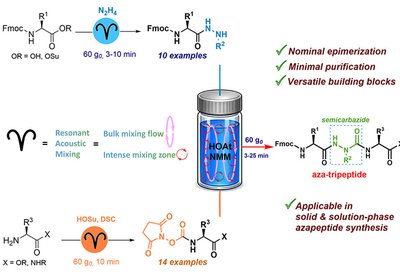
A resonant acoustic mixing strategy solves long-standing problems in azapeptide synthesis, delivering scalable aza-tripeptide building blocks without epimerization, hydantoin formation, or chromatographic purification
Amide Proteome Mapped
Raj Lab
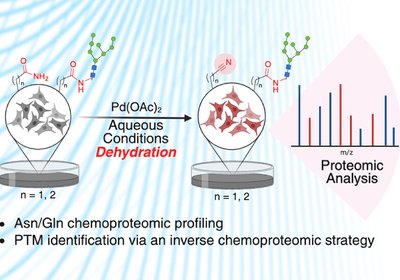
A palladium-mediated dehydration reaction converts asparagine and glutamine amides to nitriles, opening nearly 9% of the human proteome to chemoproteomic interrogation for the first time...
Silent Residues, Activated
Raj Lab
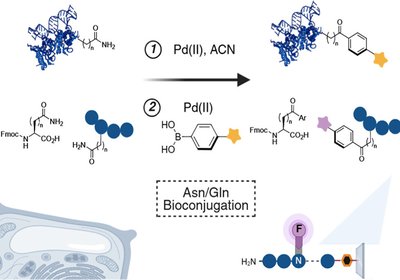
Asparagine and glutamine make up over 8% of the human proteome yet resist chemical modification — until now, when a palladium-mediated strategy converts their amide …
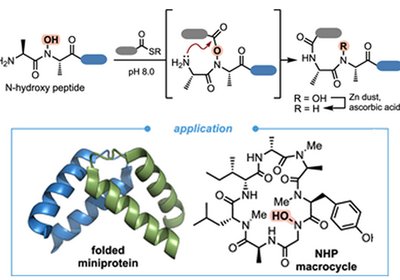
Backbone Bonds Unlocked
Del Valle Lab
A backbone hydroxamate group enables sequence-agnostic peptide ligation in water, bypassing thiolated amino acids and opening convergent routes to folded miniproteins and macrocyclic natural products
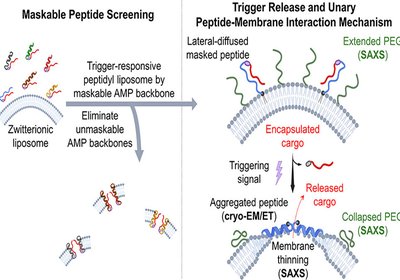
Masked Magainin
Lee Lab
Researchers supervised by Professor Hsien-Ming Lee at the Institute of Chemistry, Academia Sinica, Taipei, Taiwan, published in J. Am. Chem. Soc., screened nine cationic …
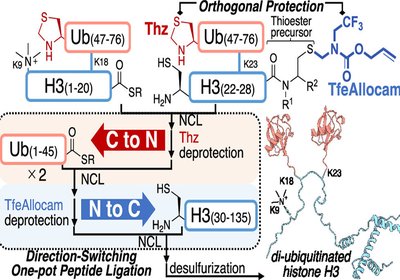
Switching Ligation Directions
Hayashi Lab
Researchers in the Hayashi, Murakami, and Okamoto Groups at Nagoya University and the University of Tokyo, published in the Journal of the American Chemical Society …